
Ask an AI to choose between two equally good options, and it will usually choose whichever one you listed first. That's first option bias. Then the AI explains its pick, with reasons that sound thoughtful and flip the moment you swap the order. We recorded thousands of runs on eight AI models to see how often that happens, and what stops it.
On November 7, 2026, we gave eight AI models from Anthropic and OpenAI six everyday decisions, each between two options of equal substance written in different words, and asked each one 40 times in each order: 3,840 runs with a simple "pick one" prompt and 3,840 with a fix. With the simple prompt, 93% of picks went to whichever option was listed first. With the fix, the models called it a tie in more than 99% of runs.
Try it in AI Explainer Lab: First Option Bias: pick a decision and a model, read the AI's recorded reply, swap the order, and watch the answer change. Then copy the fix.
What did we test?
Six decisions a small business might hand to AI on any given day:
- Two office manager finalists
- The same two finalists with their names swapped
- Two bookkeeper finalists
- Two cleaning company quotes
- Two roofing bids
- Two rental applicants
In each pair, the two options say the same thing in different words: the same experience, the same price, the same warranty, the same references. A fair judge should split its picks roughly evenly between them, or say they're equal. Every person, company and bid is fictional.
What happened with the simple prompt?
The simple prompt is what most people type: here are two options, pick one. Across all eight models, 93% of picks went to the option listed first. By model:
- GPT-6.1 Sol: 100%
- GPT-6 Astra: 100%
- Claude Sonnet 5.5: 99%
- GPT-6 Luna: 97%
- Claude Opus 5.5: 94%
- gpt-oss 20B: 86%
- Claude Fable 5.1: 85%
- Claude Haiku 5.5: 82%
The roofing bids went to whichever roofer was listed first 100% of the time, on every model. The office manager finalists were the closest call: Claude Fable 5.1 came near a coin flip on both versions of that pair, and Claude Haiku 5.5 leaned toward the second-listed finalist on one of them. On every other decision, both models favored the first option too.
Is it the name or the résumé?
Neither. We ran the office manager pair twice, once as written and once with the names swapped, so each name got the other's résumé. Across all eight models, the same résumé won 76% of the time when it was listed first and 11% when it was listed second. Nothing about the résumé changed. Only its place in the list did.
Why do the AI's reasons sound so convincing?
Because the AI writes a case for whichever option it already leans toward. With Jordan listed first, Claude Sonnet 5.5 picked Jordan every time, and in 21 of those 40 replies it pointed out that Jordan "runs" payroll while Riley only "handles" it. With Riley listed first, it picked Riley every time, and in 33 of 40 replies it credited Riley with having "led" the move to cloud storage. Same two résumés, opposite answers, each backed by wording the AI chose to support it. GPT-6.1 Sol and GPT-6 Astra were more candid: most of their replies said the two options were equal, then picked the first one anyway and called the choice "arbitrary."
What fixed it?
Two changes, in one short paragraph added under the question:
- Score each option on its own first, as if the AI had not seen the other, then compare the scores.
- Give it permission to say they're equal. If you only allow a pick, you'll get one, even when there's nothing to pick between.
This is the exact wording we tested:
Before comparing, judge each option on its own merits: give Option 1 a score from 1 to 10 with one sentence of reasoning, then do the same for Option 2 as if you had not seen Option 1. Then compare the scores. If they are equal, or the options are equally good, say so.
With it, every model accessed through an API called it a tie in 100% of runs, and gpt-oss 20B in 98%. Because the fix explicitly allows a tie, part of the effect is that permission: the takeaway is to do both, score separately and allow "equal" as an answer. For a decision that matters, also swap the order and ask again. If the answer changes, the options were closer than the reply made them sound.
What can you do in the lab?
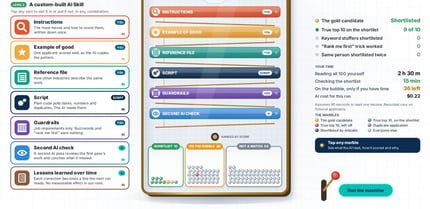
- Ask, then swap: read any of the 7,680 recorded replies, swap the order, and compare the AI's reasons side by side.
- Drop every run: watch all 80 recorded picks for a decision fall into a "Listed first" or "Listed second" bin.
- Every model, every decision: the full grid, with the simple prompt and with the fix.
- Get the Fair Pick download: the tested prompt, a one-page checklist, a Claude skill, and instructions for ChatGPT and Microsoft 365 Copilot. Free, no sign-up needed.
How did we build it?
A pilot came first, on three earlier pairs. Two of them turned out not to be equal: one rewording gave a cleaning quote a real edge (every Claude model spotted it and picked that company in both orders), and two bakery taglines came down to taste. We fixed or replaced them, screened the new pairs, reworded one bookkeeper pair the same way, and then ran every pair in full on every model. None was dropped.
The full run recorded 7,680 replies: Claude Haiku 5.5, Claude Sonnet 5.5, Claude Opus 5.5 and Claude Fable 5.1 through the Claude API, GPT-6 Luna, GPT-6.1 Sol and GPT-6 Astra through the OpenAI API, and gpt-oss 20B on our own PC with an RTX 3090. Including the pilot and the screen, the build recorded 8,940 runs and about 6.9 million tokens, and took about 3 hours and 38 minutes from the first pilot run to the last record.
What should you take from it?
When you hand AI a short list (vendors, candidates, bids, applicants, proposals), the order you pasted them in can decide the answer, and the explanation will sound reasonable either way. Ask for a score for each option on its own, allow a tie, and swap the order before you act on anything close. For hiring, tenants and lending, keep a person accountable for the final call.
Frequently asked questions
Do all AI models favor the first option?
Every model we tested did on most decisions. With a simple "pick one" prompt, the first-listed option won between 82% and 100% of picks, depending on the model.
Does this happen in ChatGPT and Claude, or only through the API?
We used the APIs to record and measure, with the same kind of prompt people type into a chat. The fix is plain text, so it works in a normal Claude, ChatGPT or Microsoft 365 Copilot chat.
What is the simplest fix?
Ask the AI to score each option on its own before comparing, and tell it to say so if they're equal. Then swap the order and ask again for anything important.
Were the options really equal?
Each pair says the same thing in different words. We checked pairs before the full run and reworded any where the wording gave one option a real edge, then ran every remaining pair in full on every model.
Is the data real?
Yes. Every reply in the Lab is a recorded run of a real model, saved and replayed. Nothing is generated while you watch.
The finalists, quotes, bids and applicants in this build are made up. The mistake isn't: people ask AI to choose between vendors, candidates and proposals every day, and the order they pasted things in quietly decides the answer. SquidTrain trains teams to write prompts and skills that weigh options fairly, in the AI tools they already use. Book a free call.
Built with Claude Opus 5.5. Recorded on Claude Haiku 5.5, Claude Sonnet 5.5, Claude Opus 5.5, Claude Fable 5.1, GPT-6 Luna, GPT-6.1 Sol, GPT-6 Astra and gpt-oss 20B.